Who Were Your Ancestors, Really? Past the Names and Dates
Genealogy hands you a birth year and a town, never the person. Here is why ancestors stay strangers, and how to make sure your own descendants truly know you.
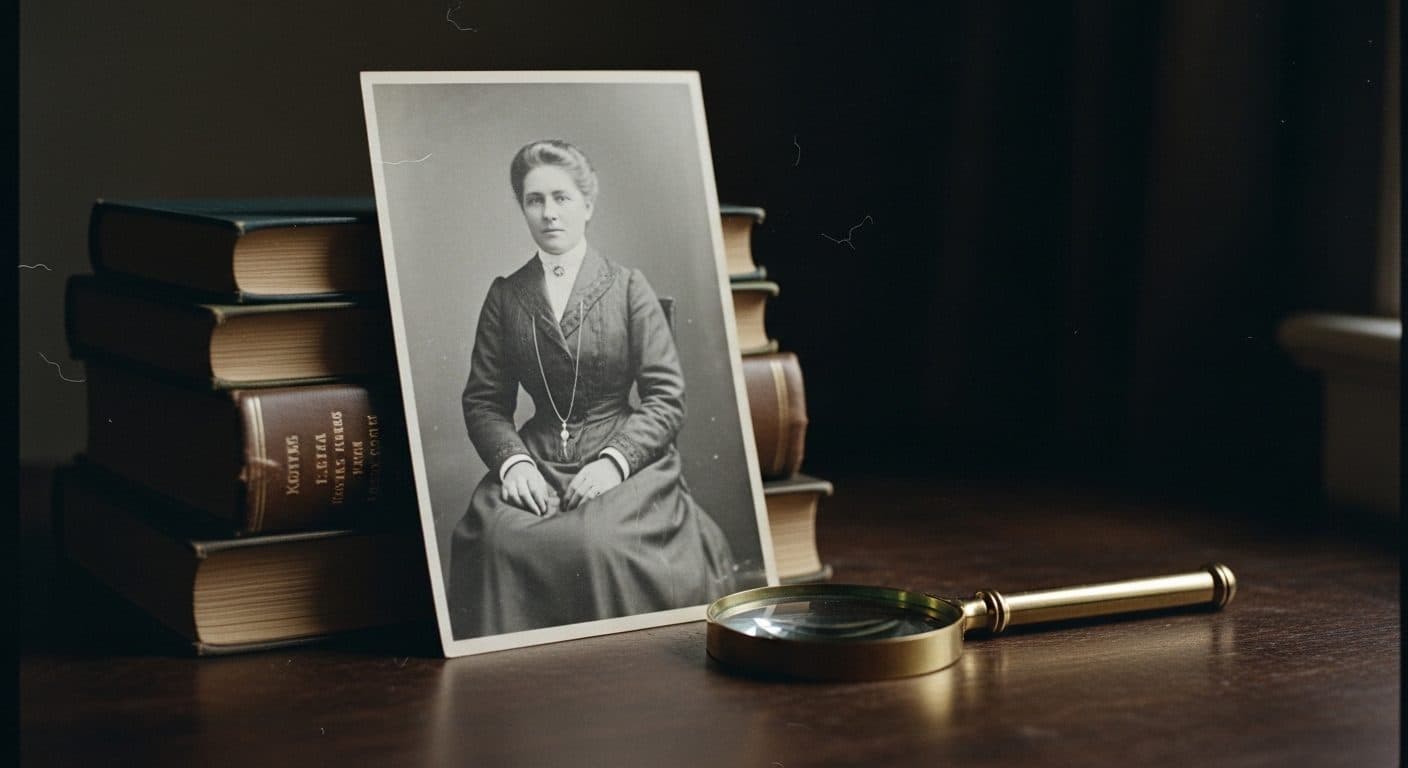
You found her on a Tuesday night, three tabs deep into a records site, when you should have been asleep. Anna. Born 1897, a town in Galicia you had to zoom the map twice to find. Married at nineteen. Six children, two of whom did not survive their first winter. A ship manifest with her name spelled two different ways on the same page. And one photograph: a woman in a dark dress, unsmiling because the exposure took too long to smile through, looking just past the camera at something you will never see. You sat there wanting to ask her one question. Any question. And the screen had nothing left to give you.
Knowing who your ancestors really were means knowing the person behind the records: their voice, their humor, their fears, the reasons behind their choices. Genealogy preserves the facts of a life, such as names, dates, places, and lineage. It almost never preserves the life itself. The two are different kinds of knowledge, and the second one is the kind that vanishes first.
This is the quiet disappointment at the center of family history. You go looking for a person and you come back with a skeleton. Accurate, verifiable, sometimes beautifully detailed, and yet completely silent on everything that made them someone you might have loved.
The Gap Between a Record and a Person
A genealogical record is a remarkable thing. It can tell you that your great-grandfather crossed an ocean in steerage in 1912, that he listed his occupation as "laborer," that he carried eleven dollars and the address of a cousin in a city he had never seen. These are real facts, hard-won by archivists and indexers and the people who spent weekends squinting at microfilm.
But read that record again and notice what it cannot say. It cannot tell you whether he was afraid. It cannot tell you if he looked back at the shore or refused to. It cannot tell you what he missed most in the years after, or whether he ever stopped missing it, or what he said to his own children when they asked him why they had left. The record holds the decision. It loses the reason. And the reason was the whole story.
This is the part nobody warns you about when you start. You think the wall is a lack of documents. You think that if you just find one more census, one more parish entry, the person will come into focus. They never do. The documents are not the bottleneck. The bottleneck is that the inner life of a human being was never written down by anyone, least of all by the person living it.
What the Records Will Never Hold
Sit with the specific things you cannot recover, because the specificity is the ache.
- Their laugh. Whether it was loud or hidden behind a hand. Whether it came easily or had to be earned. A laugh is the most particular thing about a person and the first thing the record drops.
- Their grudges. The brother they stopped speaking to, and why. The neighbor. The old wound carried for forty years that shaped every family gathering without ever being named.
- Why they left. Not the date of departure. The reason. Hunger, a war, a marriage that fell apart, a chance they could not turn down, a thing they were running from and never told a soul.
- What they believed. Not their listed religion. What they actually thought about God, luck, money, their own children, the country that took them in and the one that pushed them out.
- How they sounded. The accent, the phrases they overused, the way they told a story long after everyone knew the ending. Voice is identity, and almost no one before this generation left a recording of theirs.
You can fill a binder with their facts and still not know a single one of these things. That is not a failure of your research. It is the nature of the medium. Records were never built to hold a person. They were built to hold a transaction between a person and a government, a church, a ship line. We have mistaken the receipt for the life.
Why This Keeps Happening, Generation After Generation
For most of history, the people who knew the answers were simply expected to pass them down by being in the room. Stories lived in proximity. A child grew up hearing why their grandfather left home because the grandfather was at the table, telling it again, slightly differently each year. Knowledge moved by repetition and presence.
That transmission system has quietly broken. Families scatter across continents. Three generations rarely share a roof, often not even a time zone. The long evenings where stories used to surface have been replaced by short calls and shorter texts. And so the oldest member of a family dies holding decades of unrecorded experience, and the family discovers, weeks too late, all the questions they meant to ask. We have written about this slow erosion in our guide to connecting generations through family history, and it is worth understanding the mechanism, because the mechanism is what you are about to interrupt.
Genealogy is, in a sense, a rescue operation mounted after the loss. It reconstructs from paper what should have been passed down by voice. The dedicated people who run that rescue do extraordinary work, and if you want to do it well, our walkthrough on how to research your family history covers the records side properly. But there is a hard limit to reconstruction: you can recover where someone was, and almost never who they were. To understand why the search itself has this ceiling, see why family history goes beyond genealogy.
The Quiet Realization
Here is the turn, and it is the reason this article exists. Everything you just felt staring at Anna's photograph, that hunger to know the real person and the silence that answered it, is exactly what your great-granddaughter will feel about you.
Think about what you are actually leaving behind right now. A handful of photos, most of them unlabeled. Some accounts that will be deactivated or scrubbed. A few legal documents. Maybe a will. In a hundred years, a descendant of yours will sit somewhere, late at night, three tabs deep, and find your name and two dates and a face looking just past the camera. And they will want to ask you one question. And you, like Anna, will have nothing left to give them. Not because you had nothing to say. Because no one built the place for you to say it, and you assumed someone would remember.
They will not remember. They cannot. Memory dies with the people who hold it, and the people who hold yours will die too. The only version of you that survives is the version you record yourself, in your own voice, while you still have it. This is the part you control. As it turns out, it is the only part.
You do not have to leave your descendants digging through records for a stranger who happens to share their blood.
Download Eternem free and start leaving the real you.
Be Known on Purpose
There is a different way to do this, and it does not require you to be a writer or to sit down and compose a memoir you will never finish. ETERNEM is built on one idea: the person should leave the record of themselves, in the first person, while they are here to do it. Not the receipts. The life.
It works the way memory actually works, in moments rather than essays. You speak, and Eterna, the app's companion, transcribes and gently shapes what you said while keeping your original audio exactly as it was, accent and pauses and all. You tell the story of why you really left home, the grudge you never explained, the laugh nobody thought to capture. Each of these becomes a sealed capsule, encrypted with AES-256-GCM, that you can lock to a date, a moment, a place, or simply keep until you choose to share it.
And then there is the part that would have stopped you cold on that Tuesday night. Over time, the app learns enough of a person from their own capsules that it can represent them to the people who come after, answering in their words and even their voice. Picture reaching Anna's photograph again, only this time you ask your question and something genuinely hers answers back. That is what you can leave. Not a guess your descendants reconstruct from paper. You, on purpose, in advance.
This does not replace the records search, and it should not. Ancestry, MyHeritage, FamilySearch, and StoryWorth do real work mapping who you are related to and storing what was documented. Eternem holds the part they were never built to hold: who a person actually was. If you have already taken a test and felt the same wall, you may recognize the feeling described in our piece on what comes after the DNA test. And if you want to be certain the right person finds you a century from now, read how to make sure your descendants find you.
Where to Start, Tonight
You do not need a plan or a free weekend. You need one story you have never told properly. Maybe it is the real reason for a move. Maybe it is a person you loved and never described to anyone. Open the app, press record, and talk the way you would talk to someone who loves you and was not yet born.
Then do it again next week. The archive builds itself in small pieces, the same way a life does. If you want a gentler on-ramp, our guide to preserving family stories walks through how to draw out the ones that matter most, and those same questions work just as well turned on yourself as on a grandparent.
The woman in the dark dress did not get this chance. Almost no one before us did. You are, by accident of timing, among the first human beings who can simply hand the future the truth of themselves instead of leaving them to excavate it. That is a strange and enormous gift, and it expires with you.
Get Eternem free and make sure your descendants know the real you.