Use Case
The recipe card is in her handwriting. The voice that taught it is gone.
Eternem lets grandparents leave recipes, immigration stories, and lullabies in their own voice, time-locked to open for grandchildren at weddings and milestones. Free to download.
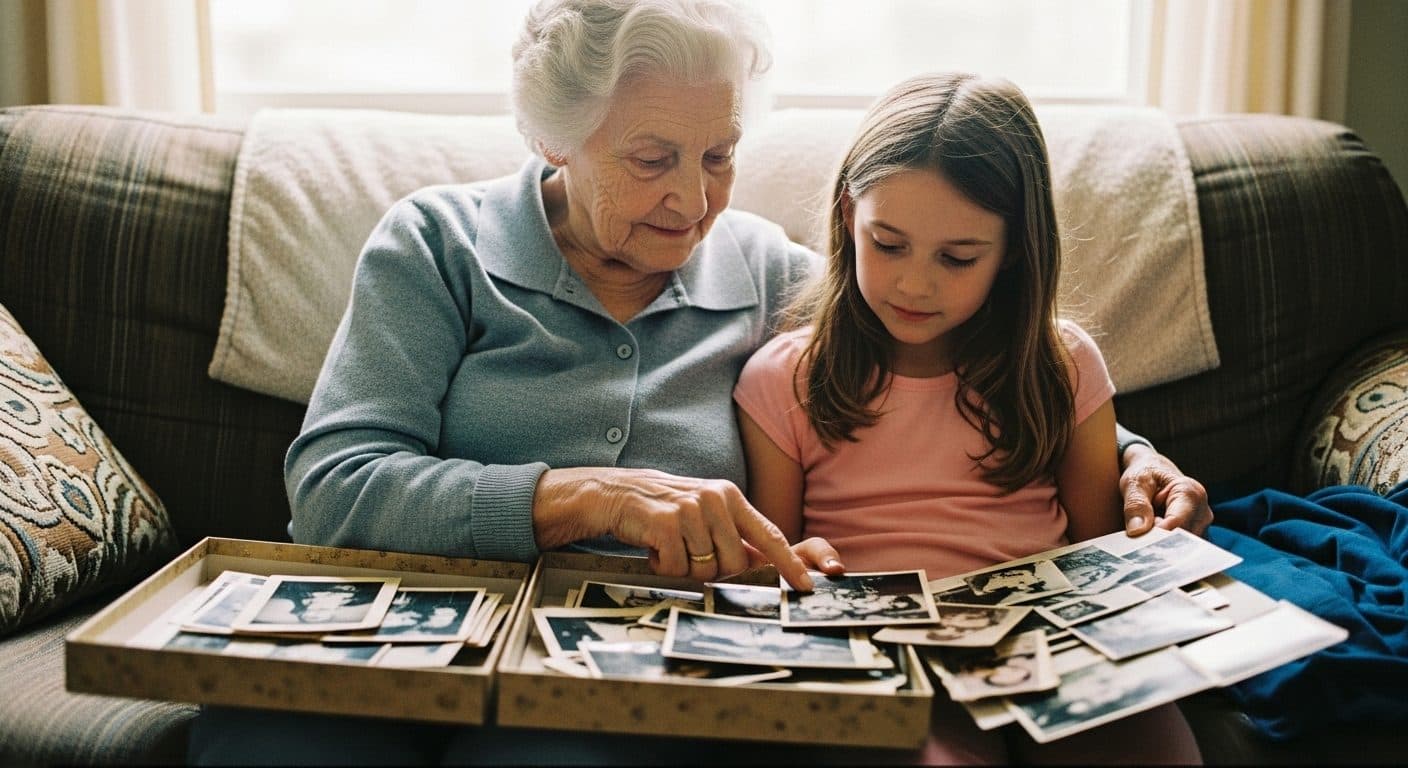
Rosa Delgado kept her tamale recipe in her head. When her granddaughter Mia finally asked her to write it down, Rosa laughed and said the masa tells you when it's ready, you can't write that. So they stood in the kitchen instead, Rosa's hands over Mia's, and Rosa talked the whole time, about the Christmas her mother first taught her in Michoacán, about the year they had no money for pork and used beans and nobody complained. Mia remembers it was a good afternoon. She does not remember most of what Rosa said. The recipe card on the fridge has the measurements. It does not have the masa telling you when it's ready, and it does not have Rosa's voice.
That is the gap every family runs into. The things that get written down are the things that were easy to write down. The reasons, the asides, the sound of the person, the small inherited wisdom that only comes out while your hands are busy, those vanish in a single generation unless someone deliberately keeps them. A preserve family legacy app exists to keep exactly that layer: not the dates and the spelling of names, but the voice and the meaning underneath them.
What a Family Legacy Actually Is
A legacy is not a will and it is not a photo album. A photo shows you that your great-grandmother existed and what she wore to a wedding in 1948. It cannot tell you why she crossed an ocean at nineteen, what she was afraid of, what she sang to her children when the lights were out. That second category is the legacy. It is the part that makes a descendant feel related to you rather than merely descended from you.
Most families lose it the same way. The stories live in one or two elders, they get told at holidays to people half-listening, and then there is a funeral and a long silence where the stories used to be. Genealogy research can rebuild the skeleton afterward, the branches and the dates, but it cannot put the voice back. We wrote about that limit in family history beyond genealogy: the record sites prove who you are related to, and they are very good at it, but they were never built to hold who those people were. The legacy lives in the second layer, and the second layer is the one actively disappearing.
Build a Family Circle, Not a Single Account
A legacy is a group project, so Eternem is built around the group. A Family Circle is a private, encrypted space where everyone who carries a piece of the family can add to one shared archive. Grandma records the tamale recipe out loud, the way she actually makes it. An uncle in Texas adds the story of how the family name got changed at the border. A cousin uploads the scan of the only photo from the old country. A daughter records the lullaby her mother sang, before she forgets the second verse the way her mother almost did.
Nobody has to be in the same room, or even the same decade of comfort with technology. The point of a Circle is that the history stops depending on a single memory and a single afternoon. It becomes a living collection that several generations build together and that survives any one of them. This is the same instinct behind a family time capsule, scaled up from a single sealed box to an ongoing, multi-voice record.
Let Grandparents Just Talk
The biggest reason family stories never get saved is friction. Asking an eighty-year-old to type her life into a phone is a fast way to get nothing. So the core of Eternem is Voice-to-Capsule: a grandparent presses record and simply talks. Eternem keeps the original audio, the accent and the pauses and the laugh, and also produces a clean, readable transcript so the words are searchable later.
That distinction matters more than it sounds. A transcript of Rosa's recipe would give Mia the measurements. The audio gives her the masa telling you when it's ready, in Rosa's actual voice, the rhythm of how she explained things, the part where she got quiet talking about her mother. A descendant fifty years from now does not just read that their great-great-grandmother made tamales every Christmas. They hear her do it. If you want a structure for the conversations themselves, our guide on how to preserve family stories before it's too late has a practical interviewing playbook for sitting down with an elder.
Time-Lock the Stories to the Moments That Need Them
The most powerful thing a legacy can do is arrive on time. Eternem capsules can be time-locked to open on a future date, at a specific moment, or when a milestone arrives, so a grandparent can speak directly to a future they will not be present for.
- Rosa can seal the tamale recipe to unlock on Mia's first Christmas in her own home, with a message: now it's yours, here's how my mother taught me.
- A grandfather can record a few minutes for each grandchild's wedding day, sealed to open the morning of, so his voice is in the room even if he is not.
- A lullaby can be locked until the birth of a great-grandchild nobody has met yet, so the first song that baby's parent reaches for is the real one, sung by the right person.
This is the difference between an archive and a legacy. An archive sits there waiting to be searched. A legacy shows up at the wedding, at the graduation, at the kitchen table on the first Christmas alone, exactly when a grandchild needs to hear that voice most. You can read more about that mechanic in our family history overview, where the time-lock becomes a way for generations who never overlapped to actually meet.
So Descendants Hear the Actual Voice, Not a Guess
Eternem includes an AI companion called Eterna that learns a person from the capsules they leave: the stories, the phrasing, the way they answer. Over time, with enough of a grandparent's own words, Eterna can represent them to future generations in text and voice, so a great-grandchild can ask a question and hear an answer shaped by who that person actually was, rather than a guess assembled from a census line.
This only works because it is built on the person's real recordings, not invented. It is the difference between a descendant wondering what Rosa would have said and a descendant hearing something genuinely close to it, grounded in the hours of her own voice she chose to leave behind. The honest version of why this matters is in making sure your descendants find the real you: leave the voice on purpose, or be reconstructed from scraps.
Private by Design, Built to Last Generations
A family legacy is the most personal data there is, so Eternem treats it that way. Everything is protected with AES-256-GCM encryption. There is no public feed, no advertising, no algorithm deciding which of your grandmother's stories gets engagement. Nothing is mined and nothing is sold. The whole product is the opposite of social media: it is built to be opened in fifty years by someone who loves you, not scrolled past in five seconds by a stranger.
That orientation changes how it feels to use. You are not performing your family for an audience. You are quietly building something for the specific people who will come after you, on a platform designed to still be standing when they go looking.
Start With One Voice This Week
You do not build a legacy by planning it. You build it by recording one thing before the next holiday becomes the one you meant to ask at. Sit your grandmother down while she cooks. Get the recipe in her voice, the way she actually explains it, the part about her mother. That single capsule is more than most families ever manage to keep, and it is the seed of the whole Circle.
Rosa's recipe card is still on the fridge. The measurements are right. But the afternoon, the masa telling you when it's ready, the Christmas with no money for pork, all of that lived only in Rosa, and most of it left with her. It did not have to. Eternem is free to download on iOS and Android. Start your family's legacy here, with one recording, in the voice your grandchildren deserve to hear.
Common questions
- What is a family legacy app and how is it different from genealogy sites?
- A family legacy app preserves who your relatives actually were, in their own voice and words, rather than the dates and documents that genealogy sites store. Ancestry and FamilySearch prove who you are related to and build the verified family tree. Eternem captures the layer they cannot: recipes explained out loud, immigration stories, lullabies, and personality, recorded by the people who carry them and saved for descendants. A complete family history uses both, the record sites for the lineage and Eternem for the lived memory.
- How does a Family Circle work in Eternem?
- A Family Circle is a private, encrypted space where multiple family members contribute to one shared history. A grandparent can record a recipe, an uncle can add the story behind the family name, a cousin can upload an old photo, and a daughter can record a lullaby, all into the same collection. Nobody needs to be in the same room or the same country. It means the family history stops depending on a single person's memory and becomes something several generations build together.
- Can my grandparents use it if they aren't comfortable with technology?
- Yes. The core feature, Voice-to-Capsule, only requires pressing record and talking. Eternem keeps the original audio and automatically creates a clean written transcript, so an elder never has to type their life story. They simply tell it the way they always have, and the app preserves both the sound of their voice and a searchable version of the words.
- How do time-locked capsules unlock for grandchildren?
- A capsule can be sealed to open on a future date, at a specific moment, or when a milestone arrives, such as a grandchild's wedding, a first Christmas in a new home, or the birth of a great-grandchild. The grandparent records the message now and sets when it should be delivered, so their voice arrives exactly when the descendant needs to hear it, even years after the recording was made.
- Will descendants really hear the actual voice, or an imitation?
- They hear the actual recordings the person left, preserved with the real audio, accent, and pauses intact. Eternem's AI companion, Eterna, additionally learns from those capsules over time and can represent the person to future generations in text and voice, but it is grounded in their genuine words and stories rather than invented. The more a relative records, the more faithful that representation becomes.
- Is my family's data private, and how much does Eternem cost?
- Everything is protected with AES-256-GCM encryption, and there is no public feed, no advertising, and no algorithm. Nothing is sold or mined. The platform is designed to be opened by your descendants decades from now, not exposed to strangers today. Eternem is free to download on iOS and Android.