Family History Beyond Genealogy: Records vs. Memory
Genealogy tells you who you are related to. It rarely tells you who they were. Here is how lived memory completes the record sites can never reach.
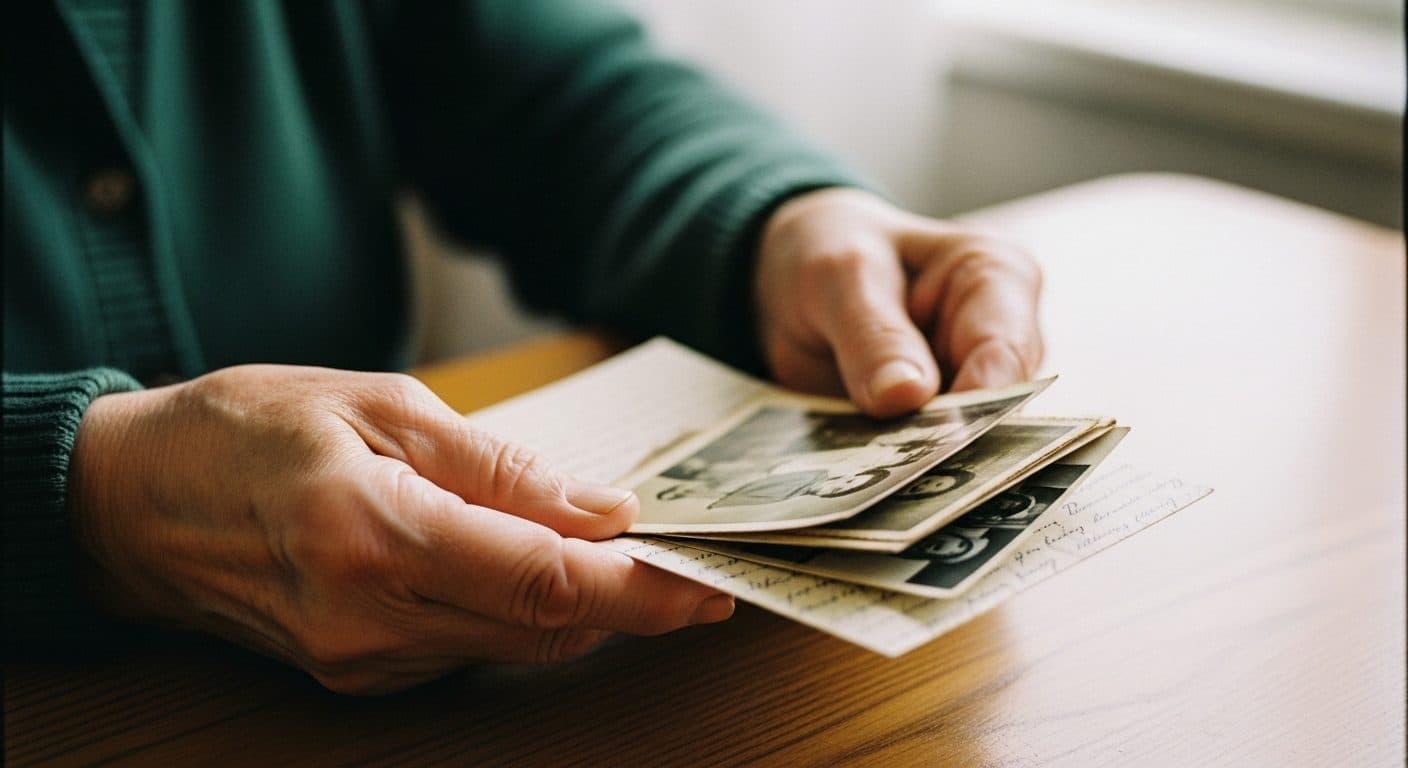
My great-grandfather's entry in the census reads: Stanisław, age 34, occupation laborer, arrived 1912. Four words and two numbers for a man who crossed an ocean alone, who my grandmother said could whistle any bird back to him, who refused to speak the old language at the dinner table because he had decided his children were American now. The record kept the laborer. The family almost lost the whistler.
Family history beyond genealogy is the part of your lineage that records cannot hold: the voice, the reasons, the temper, the way someone loved. Genealogy maps who you are related to and proves it with documents. Lived memory preserves who those people actually were. A complete family history needs both layers, because a name with two dates is a fact, not a person.
This is not an argument against genealogy. Record research is one of the great democratized hobbies of the last twenty years, and the platforms that power it are genuinely good at what they do. The argument is narrower and, I think, more useful: knowing that you are related to someone is the beginning of the question, not the answer. Here is where the two layers divide, what each does well, and how to stop the second layer from disappearing in your own generation.
What Genealogy Does Well
Give the record sites their due, because they earn it. Ancestry, FamilySearch, and MyHeritage have digitized and indexed billions of documents that would otherwise sit in parish basements and county archives, unreadable to anyone without a plane ticket and a week to spare. They turned a specialist's craft into something you can do on a Sunday afternoon.
They establish the framework. Birth, marriage, death, census, immigration, military, land. These records build the scaffolding of a family: who married whom, who was born when, which branch went west and which stayed. Without that scaffolding, lived memory has nowhere to hang. You need the tree before you can decorate it.
They prove relationships. Family lore says you descend from a particular line. A baptismal record either supports that or quietly demolishes it. Genealogy's discipline is documentation, and that discipline corrects the drift that creeps into every family's oral account over a few generations.
They reveal the unknown. Records surface relatives nobody remembered, a sibling who died young, a first marriage no one mentioned, an entire branch that emigrated and was forgotten. DNA matching extends this further, connecting living people who share an ancestor neither of them could have named. FamilySearch, run by the Church of Jesus Christ of Latter-day Saints, offers much of this for free and has become a backbone of serious amateur research.
None of this is in dispute. If you want to know the shape of where you come from, these tools are the right ones, and you should use them. The point is what they are structurally unable to give you.
What the Records Leave Out
A record is a snapshot taken by a clerk for an administrative purpose. It captures what the state needed to know and nothing the state did not care about. So the census tells you my great-grandfather was a laborer. It does not tell you he hated the work, or loved it, or that he took a second job to send money back to a sister he never saw again.
Think about what defines the people closest to you right now. Your mother's laugh. The specific way your father gives advice, circling the point three times before landing on it. The phrase your grandmother used when she was furious but trying to be polite. None of that appears in any document that will outlive them. The descendant who goes looking for your mother two generations from now will find a birth certificate, maybe a marriage license, a digital footprint scrubbed by whatever platforms have died by then. They will not find the laugh.
This is the gap. Genealogy answers "who am I related to, and can I prove it." It does not answer "who were they, really." That second question is the one most people are actually chasing when they start a family tree, and it is the one the records were never built to hold. We dug into this directly in our look at who your ancestors really were, and the honest answer is that for almost everyone before the present generation, the human texture is simply gone.
The Two Layers of a Family History
It helps to name the layers plainly, because conflating them is the source of most disappointment in family research.
The record layer. Documents, dates, lineage, DNA, the verified tree. This layer is external. It was created by institutions about your family, often without your family's involvement, and it survives because institutions keep archives. It is durable, searchable, and growing every year as more material is digitized.
The memory layer. Voice, story, motive, personality, the felt experience of a life. This layer is internal. It exists only inside living people and the things they choose to leave behind. It is fragile, rarely searchable, and shrinking every year as the people who hold it die. An elder carries decades of unrecorded stories, and most of them leave with that person unless someone thought to capture them first.
Here is the asymmetry that should change how you spend your time. The record layer is mostly safe. Those census pages are not going anywhere; they will still be there for your grandchildren to find. The memory layer is the one actively vanishing. Yet most people pour their effort into the safe layer, because it is the one with a search bar, and neglect the fragile one, because it requires sitting in a room and asking hard questions of someone who is still alive.
Why Lived Memory Disappears First
Memory does not survive by default. It survives only when someone deliberately captures it, and the conditions for that capture keep getting worse.
For most of history, family stories passed down through proximity. Generations lived close, ate together, repeated the old accounts at every gathering until the children knew them by heart. That transmission system is mostly broken now. Families scatter across continents. Three generations rarely share a roof. The unstructured hours where stories used to surface, the long dinners, the slow afternoons, have been compressed or filled with screens.
So the stories now depend on intentional recording, and intention is exactly what gets postponed. We assume there will be another visit, another holiday, another chance to finally ask Grandpa about the war. Then there is a phone call, and there is not. Every elder is a library, and the libraries are closing one by one with no copies made. Our pillar guide on connecting generations through technology goes deeper on why this transmission breakdown matters for the people inheriting the silence.
How Record Sites and Memory Tools Fit Together
The mistake is treating this as a competition. It is a stack. Each layer sits on the one below, and a serious family archive uses all of them deliberately.
- Genealogy platforms (Ancestry, FamilySearch, MyHeritage) build the verified tree and connect you to relatives across centuries. They answer who are we related to.
- Photo and document archives (Google Photos, scanned letters, heirloom records) hold the visual and material trace. They answer what did we have, what did we look like.
- Prompt-based memory books (StoryWorth and similar) coax written reminiscence out of a living relative over a year of email prompts, then bind it into a book. They answer what does this person remember, in writing. We compare that approach in detail in Eternem versus StoryWorth.
- Lived-memory preservation (Eternem) captures the person in their own voice and personality, time-locked and encrypted, so the texture survives intact. It answers who were they, actually.
You do the DNA test, you build the tree, you find the branch you never knew about. Good. Now what comes after the DNA test is the harder and more valuable work: making sure the living people that test connected you to are recorded as people, not as future census entries. The record proves the relationship. Only memory makes the relationship mean anything.
Where Eternem Sits in the Stack
Eternem is not a genealogy service and does not pretend to be one. It does not index census records or build a tree. It does the thing the record sites structurally cannot: it preserves who a person actually was, in their own first-person voice, for descendants who otherwise would have only the four words and two dates.
The mechanics are built for the memory layer specifically. Voice-to-Capsule lets a relative simply talk; Eternem transcribes and gently cleans up the speech while keeping the original audio, so you preserve both the readable account and the actual sound of the voice, the accent, the pauses, the laugh. Time-locked capsules let an elder seal a story to open at a future date, a grandchild's eighteenth birthday, a reunion a decade out, so the message arrives when it lands hardest. Circles turn this into a family project, a private encrypted group where an aunt in Melbourne and a cousin in Chicago contribute to one shared, multi-perspective history. And Eterna, Eternem's AI companion, learns a person from their capsules and can later represent them to future generations in text and voice, so a descendant can ask a question and hear something close to a real answer rather than guess from a document.
All of it is private by design: AES-256-GCM encryption, no feed, no ads, no algorithm mining your family's grief for engagement. The whole orientation is the opposite of social media. It is built to be opened in fifty years, not scrolled past in five seconds. Eternem is free to download on iOS and Android. Start your family's memory layer here.
Don't Make Your Descendants Dig
The clearest way to understand the value of the memory layer is to invert your own frustration. Every time a record search left you holding a name and nothing else, every time you wished the document could tell you why she left or what he sounded like, you were running into the limit of genealogy. Your descendants will run into the same wall, except the person on the other side of it will be you.
They will find your dates. They will find a few photos and whatever survives of your accounts. They will not find your voice unless you leave it on purpose. That is the entire premise: do not make the people who come after you reconstruct you from administrative scraps the way you are reconstructing your ancestors now. Be knowable on your own terms, in your own words, while you still hold the voice that the records can never reach. There are concrete steps for this in our guide to making sure your descendants find the real you, and a practical interviewing playbook in how to preserve family stories before it is too late.
Use Ancestry to find them. Use Eternem so they can find you. Download Eternem free and start with one voice recording this week, before the next holiday becomes the one you meant to ask at.