Feature
Seal a moment now. Open it exactly when you mean to.
Encrypted capsules of your stories, photos, video, and voice that unlock by Date, Moment, Location, or a Manual lock — combine them for one deliberate reveal.
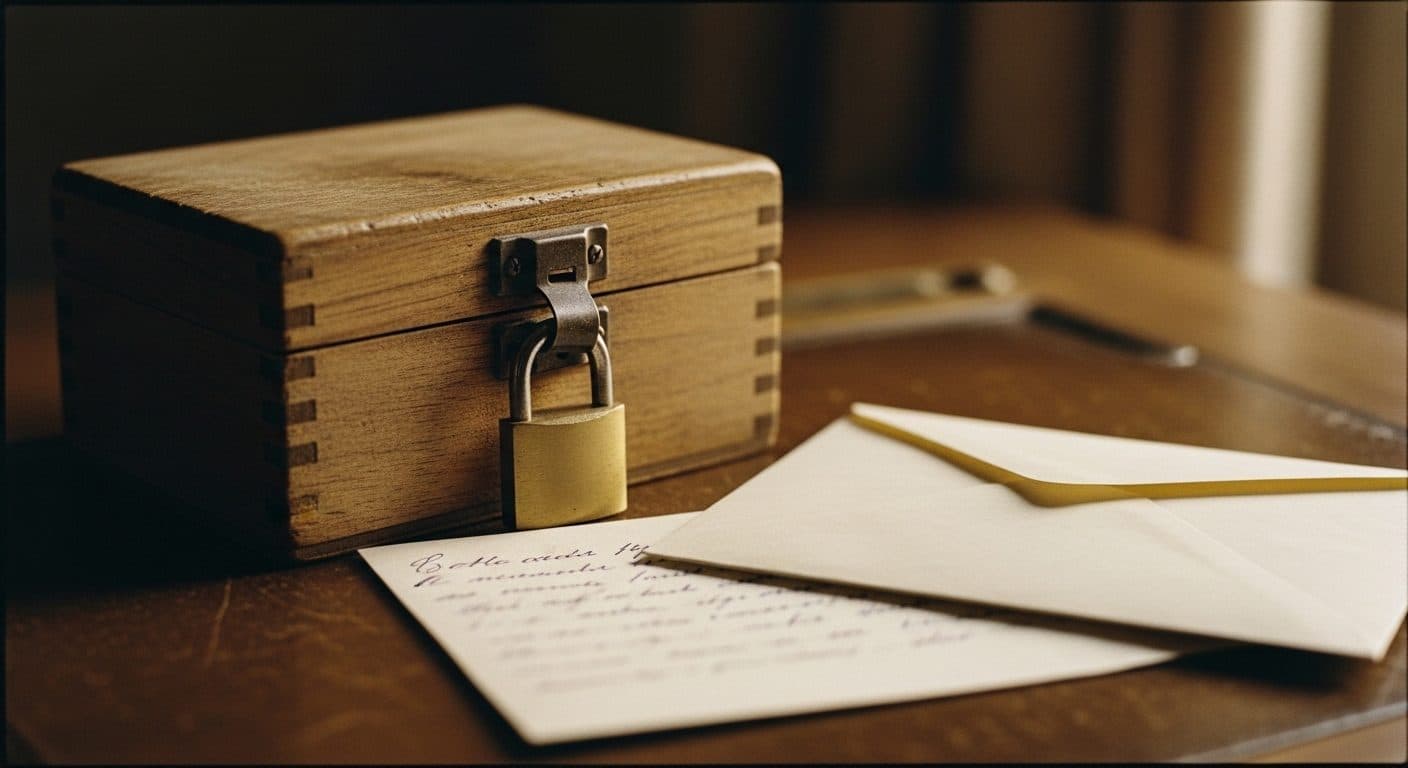
A time-locked capsule is an encrypted bundle of your stories, photos, video, and voice that stays sealed until a condition you choose is met. You can lock it to a Date, a Moment such as a graduation or a birth, a Location the recipient has to physically reach, or a Manual lock you release by hand. Combine them, and the capsule opens exactly once, exactly when you meant it to.
The idea is older than any app. People have always buried letters, sewn notes into hems, left envelopes marked "open when you turn 21." What changes here is that the message can carry your actual voice, and it cannot be opened early by accident or impatience. The lock is real, enforced by encryption rather than willpower.
What a time-locked capsule actually holds
A capsule is not a single text field. Inside one, you can gather written stories, a run of photographs, video clips, and voice recordings, and keep them together as one moment. A father recording a two-minute message the night his daughter is born can pair it with a photo from the hospital and a paragraph about what the room sounded like at 3 a.m. That whole thing becomes a single sealed object, set to open on her eighteenth birthday.
Everything is protected with AES-256-GCM encryption, the same standard banks and governments rely on. The content turns into ciphertext the moment you seal it. No feed displays it, no algorithm surfaces it, and no one — not even the people who built the platform — can read it before the lock conditions are met. It simply waits.
The four locks, and why you'd combine them
Each lock answers a different question about when a message should arrive.
- Date lock: Opens on a calendar date you set. A New Year's letter to yourself next January. A note timed to land on your parents' fiftieth anniversary. The most direct way to send something to a known future moment.
- Moment lock: Tied to a life event rather than a fixed day — a wedding, a graduation, the birth of a child, a first home. You don't always know the date years out, but you know the moment will come.
- Location lock: Opens when the recipient physically reaches a place. The house you grew up in. The overlook where you proposed. The capsule waits at those coordinates until someone stands there.
- Manual lock: Stays sealed until you choose to release it yourself. Useful when timing depends on judgment — you'll know the right week when it arrives, even if a calendar can't.
The quiet power is in combining them. A Date lock plus a Location lock means a message can only open after a certain year and only once the person is standing somewhere specific. You're not just choosing a time; you're composing a single, deliberate reveal that can't happen any other way. For a deeper look at the mechanics, see our guide to digital time capsules.
How you make one
The flow is short on purpose. You open a new capsule and add what you want inside it — type the story, drop in photos, attach video, or record straight into it with Voice-to-Capsule so your message is spoken, not just written. Then you choose how it locks: pick a date, name a moment, drop a pin, or hold it for manual release, and stack those conditions if you want more than one to be true before it opens.
You name who it's for. The recipient doesn't need to already use the app — when the lock lifts, they're notified and can open what you left them. Then you seal it, and it's gone from view until its time. That last part matters more than it sounds: a capsule you can peek at whenever you like is just a folder. The waiting is what gives the opening its weight.
Who it's for
Parents make the longest-running use of it — messages staged across a child's life, opening at five, ten, sixteen, the wedding day. Couples lock anniversary letters and the sappy things that are easier to record than to say out loud. People facing illness or simply thinking ahead use it to leave words their family will hear later; our guide to posthumous messages covers that gently and in full.
It's also for the version of you a year from now. A letter to your future self, locked for twelve months, is one of the most honest mirrors you can build — see our letter to your future self guide. And families use capsules to hold what genealogy never records: the voice behind the name, the reason behind a decision. That thread runs straight into the work of family history — preserving the people, not just the dates.
Why it matters
There's a difference between someone in 2050 reading that you existed and hearing you say so. A photograph proves you were there. Your voice, describing why a particular evening mattered, proves who you were. A time-locked capsule is built to carry the second kind of record across years without anyone able to open it too soon, lose it, or scroll past it.
No feed, no ads, no algorithm deciding when your message surfaces — only the conditions you set. Eternem is free to download on iOS and Android. Download Eternem and seal your first capsule in a few minutes. You can always make more; the hard part is sitting down to record the first one.
Common questions
- What is a time-locked capsule?
- It is an encrypted bundle of your stories, photos, video, and voice that stays sealed until a condition you choose is met. You can lock a capsule to a Date, a Moment like a graduation, a Location the recipient must physically reach, or a Manual lock you release by hand — and combine them so it opens exactly once, when you intended.
- Can I combine more than one lock on a single capsule?
- Yes. The locks stack. A Date lock plus a Location lock, for example, means the capsule can only open after a certain year and only once the recipient is standing in a specific place. Combining locks lets you compose a single, deliberate reveal that no single condition could produce on its own.
- What can I put inside a capsule?
- One capsule can hold written stories, photographs, video clips, and voice recordings together as a single sealed moment. With Voice-to-Capsule you can record your message spoken aloud rather than typing it, so the person who opens it hears your actual voice alongside the words and images.
- How secure are time-locked capsules?
- Every capsule is protected with AES-256-GCM encryption, the standard used by banks and governments. Content becomes ciphertext the moment you seal it, and it cannot be opened before your lock conditions are met — not even by the people who built the platform. There is no feed, no ads, and no algorithm exposing your content.
- Does the recipient need the app already?
- No. You name who a capsule is for, and when the lock lifts the recipient is notified and can open what you left them, even if they did not previously use Eternem.
- How much does it cost?
- Eternem is free to download on iOS and Android. You can create time-locked capsules and start sealing your first one within a few minutes of installing.