The Complete Guide to Digital Legacy
What a digital legacy is, why it matters, and how to preserve your stories, voice, and memories for the people who come after you. An honest, complete guide.
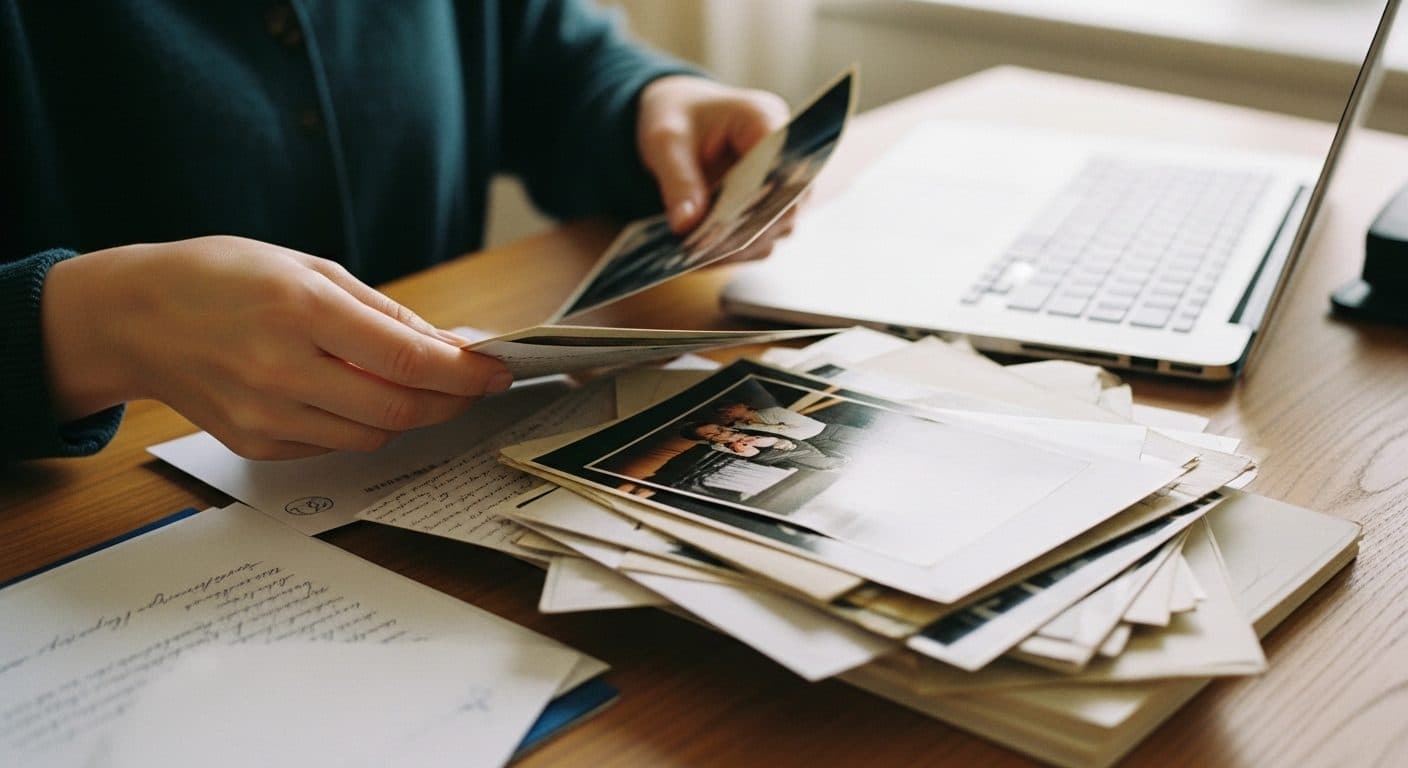
My grandfather kept a shoebox of photographs on the top shelf of his closet. After he died, we spread them across the dining table and realized none of us knew the names of half the people in them. A man in a wool coat squinting at a camera in 1952. A woman laughing on a porch we couldn't place. He was the only person who could have told us, and he was gone. The pictures survived. The stories didn't.
A digital legacy is the full body of what you leave behind online and on your devices — photos, videos, voice recordings, written stories, messages, and accounts — together with the context that makes them mean something. The version worth having carries who is in the picture, when it happened, and why it mattered to you, not just the files themselves.
Most of us never plan for it. We assume the cloud will hold, the accounts will stay open, and someone will sort it out later. They usually can't. This guide is the long version of how to do better — what a digital legacy actually includes, how it differs from estate planning, what to preserve, and how to build something your family can still open and understand in fifty years.
What a Digital Legacy Actually Is
A digital legacy is everything of yours that lives in digital form: the social profiles and email, yes, but also the cloud-stored photos, the voice memos, the writing, the financial accounts, and the small things you'd never think to label — a video of a birthday, a thread where a parent said they were proud of you.
It splits into two kinds, and the difference decides how much of it survives in any useful form.
- Passive legacy: the trail you leave just by living connected — posts, search and location history, purchase records, whatever sits in your cloud drive by default. This is what happens to your data when you do nothing.
- Intentional legacy: the memories, stories, and messages you deliberately create and keep for particular people, moments, or years ahead. Recorded oral histories. Curated photo collections. A letter your daughter opens on a birthday you won't be there for.
Passive legacy is the shoebox: things accumulate, and most of the meaning evaporates because no one wrote it down. Intentional legacy is the part where you sit beside the photo and say who that man in the wool coat was. The rest of this guide is mostly about the second kind, because that's the part worth protecting on purpose.
Why It Matters Now
Two forces make this more pressing than it used to be. The first is volume. We make staggering amounts of media — a phone fills with thousands of photos a year, almost none of them captioned, organized, or explained. A pile that large, with no context attached, isn't a legacy. It's a problem you've handed to whoever loves you most.
The second is fragility. Platforms are not permanent, and we keep relearning this the hard way. MySpace lost a vast trove of user-uploaded music and photos during a server migration. Vine, a service millions used, was shut down. Google has a long graveyard of retired products. The companies that survive still rewrite their terms, change retention policies, and adjust what they'll do with a deceased person's account. Handing one company your life's memories and assuming they'll keep them is a bet, and the house has a habit of winning.
There's a quieter reason too. Families live farther apart than they used to. The albums on the shelf and the letters in the drawer that once moved naturally between generations don't move at all when the relatives are scattered across three countries. Digital tools can close that distance — but only the ones built to preserve, not the ones built to scroll. That distinction sits at the center of the difference between social media and eternal media.
Digital Legacy vs. Digital Estate Planning
People use these terms interchangeably. They shouldn't. One is about property. The other is about a person.
Digital estate planning is the legal and financial side. It covers access to bank and investment accounts, cryptocurrency, domain names, online businesses and ad accounts, licensed software, and the designation of a digital executor in your will who has the authority to manage or close what you leave. It deals with who controls your assets.
Digital legacy planning is the personal side. It covers the photos and voice and stories, the time-locked messages meant for specific future moments, the curated collections, and the question of who gets to see them and when. It deals with who you were, kept in a form people can actually reach.
You want both. But they're not the same job, and a lawyer who's brilliant at the first may have nothing to say about the second. This guide concentrates on the legacy side — the harder, more human work. For the operational walkthrough of building one, our step-by-step digital legacy planning guide takes it task by task.
What to Actually Preserve
A real digital legacy is more than a folder of pictures. Here's the inventory worth thinking through.
Photos and videos — curated, not dumped
The visual record is what everyone reaches for first, and it's also where most legacies go wrong. Fifty thousand unsorted files in a cloud drive is not an archive; it's the dining-table shoebox at scale. Two hundred photos, each with a line about who's in it and why it mattered, is worth more than all fifty thousand. Caption as you go. The context is the gift, and the resolution is beside the point.
Voice
You can describe how someone looked. You cannot describe the sound of them — the cadence when they told a story, the particular way they said your name. Voice is the thing people grieve the hardest and record the least. Apps like Eternem include Voice-to-Capsule: you speak, Eterna transcribes and lightly enhances the text, and it keeps both the cleaned-up words and your original audio. The recording is the part that matters most, and it's the part you can't recreate later.
Written stories and reflections
Writing carries the context that images can't. Worth keeping:
- Life stories and memoir fragments — childhood, work, the relationships that shaped you, the turning points you'd want explained
- Advice and lessons addressed to specific people
- What it felt like to live through the events you lived through
- Family recipes and traditions, with the commentary that makes them yours and not a card index
- Journal entries that capture your inner weather
Messages to particular people
The most emotionally loaded part of any legacy: letters meant for one person at one time. A note for a child's eighteenth birthday. A message for a partner's fiftieth anniversary. Words for a grandchild you may never meet. Time-locked delivery means they arrive when they'll land hardest, not in an undated pile someone finds by accident. There's a whole craft to this, covered in our guide to sending messages to the future.
Social media content
Years of your life live in your posts and comments. Leaning on those platforms to keep them, though, is the risk described above. Use social media to share now; keep what matters somewhere built to last. We go deep on this in what happens to your social media when you die.
Creative and intellectual work
Essays, fiction, poetry, music you made, artwork, design files, published work, things you taught. These have meaning and sometimes legal value. Preserve the work, and clarify in your estate documents who inherits the rights.
How to Build One, Step by Step
A good legacy isn't a weekend project. It's built slowly, the way the best ones always were. Here's a framework that holds up.
Step 1 — Take inventory
List every account, cloud service, and profile you have, and mark which ones actually hold memories you'd grieve to lose. The list is almost always longer than you expect. Most of it is noise. The point is to find the handful of places where the real stuff lives.
Step 2 — Decide what's worth keeping
Not everything deserves to survive. A clean test: would someone who loves me want to see, hear, or read this twenty years from now? If yes, it's worth the effort. If you're keeping it only because deleting feels like work, let it go.
Step 3 — Pick a platform built for preservation
A cloud drive stores files. It doesn't deliver a message on a date, doesn't encrypt a private capsule end to end, doesn't help a family build something together. For a legacy you want a tool made for the purpose — with time-locked delivery, real encryption, shared spaces, and sane organization. We line up the options in our roundup of the best digital legacy platforms.
Step 4 — Start making new things, not just saving old ones
Preserving what already exists is half the work. The other half is creating what doesn't exist yet — telling the stories no one wrote down, recording your voice while you have it, writing the letters. This is where a legacy stops being an archive and starts being alive.
Step 5 — Set access and delivery
Decide who gets what, and when. Some capsules unlock on a date. Some unlock at a moment — a wedding, a birth, a graduation. Some are for one person's eyes and no one else's. A trusted contact should know the platform exists and how to reach it. A legacy no one can open is just a locked box.
Step 6 — Make it a habit
The legacies that come to mean the most are the ones that grew a little at a time. Five minutes a week — one photo with a caption, one short recording, one paragraph — compounds across years into something no one could assemble in a single sitting. Put it on the calendar. Treat it like the standing appointment it is.
How to Lock and Deliver What You Make
The mechanism matters as much as the content, because timing is part of the meaning. A message that arrives on the right day says something the same message in a folder never could. Eternem's capsules — encrypted containers for stories, photos, video, and voice — can be set to open four ways, and the conditions combine:
- Date: opens on a specific day, from tomorrow to decades out — a birthday, an anniversary, a year you choose
- Moment: opens on a life event rather than a date — a graduation, a wedding, the birth of a first child — for the milestones you can't put on a calendar in advance
- Location: opens when someone reaches a meaningful place — the house you grew up in, a town that mattered
- Manual: stays sealed until you, or a person you trust, release it
Combine them and a capsule can wait for a particular person to stand in a particular place in a particular year. That precision is what turns storage into something closer to a letter that knew when to arrive. If you want the deeper version, our ultimate guide to digital time capsules walks through how people actually use each lock.
How AI Changes What's Possible
For most of digital history, preservation meant a filing cabinet: upload, sort into folders, hope someone finds it useful someday. AI shifts what a legacy can be — from a static archive into something you can ask questions of.
The practical gains are real. Memories can be tagged and linked automatically, so a wedding photo connects to the story you wrote about that day and the recording of the vows. Search starts to understand meaning rather than just matching keywords, surfacing the right memory by theme or person or feeling.
The deeper change is personality. Eternem's Eterna learns a person from the stories, reflections, and recordings they share over time — not only what happened to them, but how they thought, what they valued, the way they phrased things. It can represent that person to future generations in text and in voice, with a library of thirteen voices, including an Act As mode that responds the way they would have. This is the part of the shoebox we never had: the photo of the man in the wool coat is one thing, but here you could ask him who he was.
None of this is without weight. How much of a person should be preserved this way? Who gets to interact with it, and when? Eternem treats those as design questions, not afterthoughts — you control what Eterna learns and who can reach it, and privacy is built into the architecture rather than promised in a policy. We work through the harder questions in our piece on AI and digital legacy.
What Genealogy Gets Right — and What It Can't Reach
Here is the bridge between the shoebox and everything above. Millions of people are, right now, trying to find out who their ancestors really were. They pay for subscriptions, take DNA tests, comb through census records and ship manifests and parish registers. And what they almost always end up with is a name, two dates, and maybe a blurry photograph. A great-grandmother reduced to a birth year and a death year. Never the laugh. Never the reason she left home and crossed an ocean with everything she owned in one bag.
Services like Ancestry, MyHeritage, FamilySearch, and StoryWorth do something genuinely valuable: they map who you're related to and pull together the records that prove it. That work is real and worth doing. But records can only carry so much. A document tells you a person existed. It can't tell you what they were like to sit across from. The descendant searching today isn't missing data — they're missing the person, and no archive of forms can give that back.
Which sets up the actual point of all this. You are someone's ancestor-in-waiting. In two generations, somebody who shares your face will go looking for you, and they'll find whatever you left — or they'll find a name and two dates. A digital legacy, built on purpose now, is how you make sure they find the person and not the placeholder. You can be the one ancestor who left their own voice, told their own story, answered the questions before anyone had to guess. Don't make your descendants dig you out of a record. Be known directly. We follow this all the way through in who were your ancestors, really and in making sure your descendants find you.
Download Eternem free and start the part of your story that records can never hold.
Building a Legacy Across a Whole Family
The strongest legacies aren't solo projects. They're things a family makes together, across more years than any one person spans.
Picture it working: grandparents recording the stories from their own childhoods, parents documenting their kids' milestones, teenagers adding their own running commentary, the little ones' first words and first drawings saved by the adults around them. Over decades that becomes a living family history — and it gets richer with every person who adds to it, because every generation sees the same events from a different chair.
Eternem Circles are built for exactly this: private groups for a family, a couple, a friend group, or an organization, where everyone contributes and the result is a shared, multi-perspective record. It's different from a shared Drive folder or a group chat, because the time-locking, the privacy, and Eterna are part of the structure rather than bolted on. We dig into the family side in connecting generations through family history and preserving family stories.
The honest challenge is getting people to take part. A few things that genuinely help: start with voice, because relatives who'd never open a journaling app will happily just talk; create a Circle so it feels collaborative instead of lonely; use occasions — birthdays, holidays, reunions — as natural prompts; and lead by example, because one person receiving a real time-locked message from you does more than any amount of explaining the idea.
The Legal Side, Briefly
This guide is mostly about the personal work, but a few legal realities are worth knowing.
Name a digital executor. Designate someone in your will with the authority to manage your accounts and digital assets. They should know your legacy platform exists, be able to reach it, and understand your wishes for different kinds of content.
Terms of service rarely allow transfer. Most platforms don't let an account pass to someone after death. A few — Facebook, Google, Apple — offer memorialization or legacy-contact features; many offer nothing. It's a strong argument for keeping what matters in a tool designed for posthumous access in the first place.
The law is still catching up. Rules for digital assets after death vary by place and keep evolving. In the United States, most states have adopted the Revised Uniform Fiduciary Access to Digital Assets Act (RUFADAA), which gives some structure. The EU's GDPR addresses data portability but applies only narrowly after death. Check your own jurisdiction and, for anything with real financial weight, talk to an estate attorney.
Mind the intellectual property. Your writing, photos, music, and design work may carry rights worth assigning deliberately. Say who inherits them.
The Mistakes Worth Avoiding
Waiting. The biggest one, and the only one you can't undo. Every day unrecorded is a day of context that quietly leaves with you. You don't need a finished plan — one capsule today beats a perfect system you'll start someday.
Treating social media as your archive. Those platforms are engineered for attention, not preservation. They change terms, remove content, and sometimes vanish. Share there; keep there nothing you'd mourn.
Choosing quantity over context. A hundred thousand unsorted photos isn't a legacy; it's a junk drawer with a search bar. One captioned photo with a recorded story behind it outvalues a thousand nameless files.
Forgetting voice. It's the most precious and the most neglected. Record stories and messages while the voice is here to record.
Hiding the keys. A beautiful archive nobody can reach helps no one. Make sure at least one person you trust knows it exists and can open it.
Over-engineering it. A system that needs five synced apps and a password spreadsheet is a system you'll abandon. Pick one primary place and keep it simple enough to sustain for decades.
Skipping privacy. Your most personal memories deserve real protection. Eternem encrypts every capsule with AES-256-GCM and runs on Google Cloud, with no feed, no ads, no algorithm, and no data mining — nothing about your story becomes someone else's product. Get Eternem free on iOS and Android and start with the one memory you'd least want to lose.
Your digital legacy is the most personal thing you'll ever make, and it isn't really about technology at all. It's about the people who come after you, and what they'll feel when they hear your voice instead of guessing at it. The tools to do this well exist now. The only missing piece is the decision to begin.